Why Holistic Care Complements Surgery for Recovery

Surgery can fix a structural problem. What it cannot do is heal the whole person who went through it. If you’ve had a hysteroscopy, D&C, or any procedure for Asherman’s syndrome or a reproductive condition, you’ve probably felt that gap firsthand. The procedure ends, you’re sent home with discharge instructions, and you’re left wondering why recovery still feels so hard. Understanding why holistic care complements surgery is the missing piece most women never get told about. This article breaks down the evidence, the practical tools, and the mindset shift that can make your recovery feel less like waiting and more like healing.
Table of Contents
- Key Takeaways
- Why holistic care complements surgery
- Holistic therapies that support reproductive recovery
- Integrative care vs. standard recovery approaches
- Practical steps to integrate holistic care into your recovery
- My honest take on holistic care and surgery
- How Theashermanscompass supports your recovery
- FAQ
Key Takeaways
| Point | Details |
|---|---|
| Surgery alone isn’t enough | Holistic care addresses mental, emotional, and physical recovery that surgical procedures cannot cover. |
| Prehabilitation changes outcomes | Exercise and nutrition programs before surgery can reduce complications by up to 55%. |
| Mind-body practices reduce anxiety | Mindfulness and yoga support emotional regulation and stress reduction throughout recovery. |
| Integrative care cuts costs | Holistic approaches save an average of $898 per hospital admission through better self-management. |
| You are an active participant | Women who engage as partners in their recovery build resilience and heal more effectively. |
Why holistic care complements surgery
Surgery addresses the physical structure. It removes scar tissue, repairs damage, or restores anatomy. But the body that goes into that operating room carries everything with it: stress levels, nutritional status, sleep quality, emotional state, and social support. None of those factors get fixed on the table.
Holistic care treats patients as interconnected systems rather than isolated problems. That means addressing the physical, emotional, social, and even spiritual dimensions of health across the entire surgical timeline, not just the hours in hospital. The perioperative period, which covers the weeks before and after surgery, is where this approach makes the most measurable difference.
One of the most underused tools in surgical preparation is prehabilitation. This is the practice of building your body’s resilience before surgery through targeted exercise, nutrition, and psychological support. Prehabilitation programs reduce postoperative complications by 48% to 55% and shorten hospital stays by 11% to 14%, based on a review of 23 trials involving more than 2,100 patients. That is not a small effect. That is the difference between a smooth recovery and a complicated one.
What does the perioperative period actually need from you? A few things that standard pre-op instructions rarely cover:
- Adequate protein intake to support tissue repair and immune function
- Reduced psychological stress, which directly affects inflammation and healing speed
- Social connection, because isolation slows recovery in measurable ways
- Movement that is appropriate for your current fitness level, not just rest
The shift toward whole-person health integration recognizes that biological, behavioral, and environmental factors all shape how well someone recovers from surgery, particularly for complex reproductive conditions.
Holistic therapies that support reproductive recovery
For women recovering from reproductive surgeries, the body needs targeted support that goes beyond rest and pain management. The good news is that several well-researched therapies work alongside your medical treatment without conflicting with it.
Nutrition for tissue repair and immune function. Nutrition prehabilitation reduces hospital stay by 14% by targeting the immune and metabolic demands of surgery. Post-surgery, your body needs zinc, vitamin C, and adequate protein to rebuild tissue. Women recovering from uterine procedures often have additional iron needs if they’ve experienced blood loss. Working with a dietitian who understands surgical recovery is worth far more than a generic multivitamin.
Gentle movement and rebuilding strength. Exercise-based prehabilitation reduces postoperative complications by 55%, especially with clinical supervision. Post-surgery, gentle walking, pelvic floor work, and progressive strength training help restore circulation, reduce scar tissue formation, and rebuild confidence in your body. The key word is progressive. Start where you are, not where you think you should be.

Mind-body practices for emotional regulation. Mindfulness and yoga improve stress modulation and reduce anxiety, which matters enormously during recovery. Elevated cortisol suppresses immune function and slows wound healing. Even 10 minutes of guided breathing daily can shift your nervous system out of fight-or-flight mode and into the parasympathetic state where healing actually happens.
Social connection and nature exposure. Spending at least 2 hours weekly in nature improves measurable health and well-being outcomes. This is not soft advice. Social isolation is a physiological stressor. Connecting with others who understand your experience, whether through a support group, a trusted friend, or an online community, reduces that stress load in real ways.
Pro Tip: Before your surgery, ask your surgeon specifically about which complementary therapies are safe to continue during recovery. Most are supportive, but some supplements affect bleeding or anesthesia. Having that conversation puts you in control of your own care.
Integrative care vs. standard recovery approaches
Most standard post-surgical care plans look like this: rest for two weeks, take your prescribed medication, attend a follow-up appointment at six weeks, and call if something feels wrong. That’s it. There is no nutrition guidance, no mental health support, no movement protocol, and no acknowledgment that you are a whole person trying to rebuild your life.
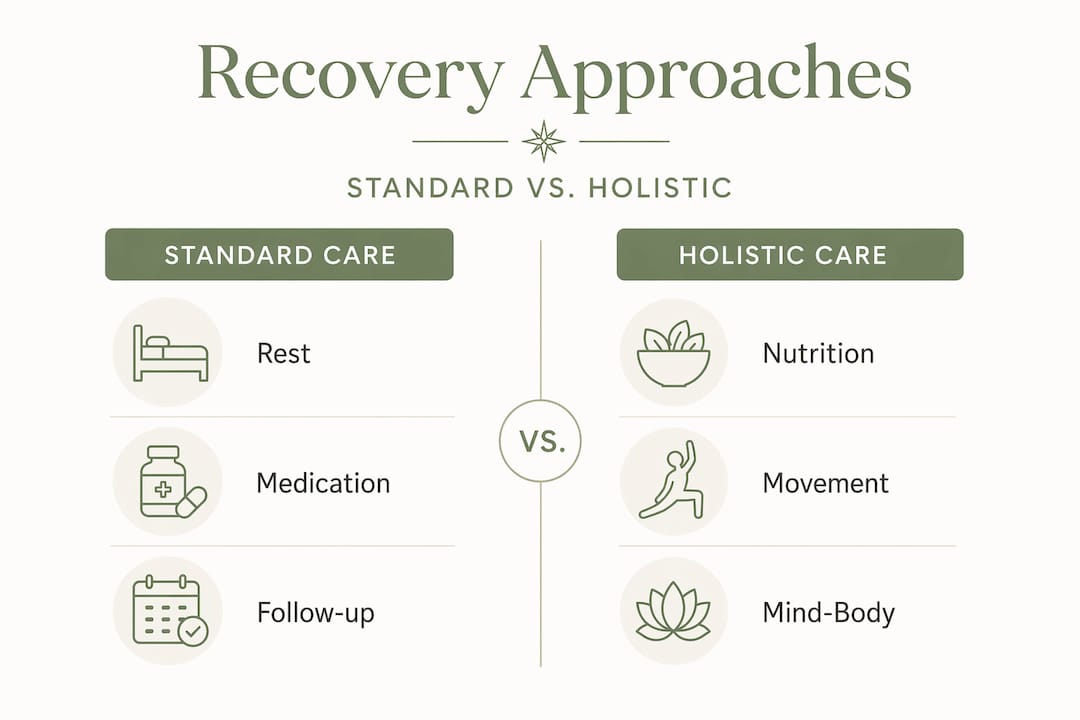
Integrative care after surgery looks fundamentally different. Here’s a direct comparison:
| Area | Standard care | Integrative holistic care |
|---|---|---|
| Nutrition | Generic discharge instructions | Personalized plan targeting immune support and tissue repair |
| Movement | “Rest and avoid strenuous activity” | Progressive exercise protocol starting within days of surgery |
| Mental health | Rarely addressed unless crisis | Mindfulness, counseling, and stress management built into recovery |
| Social support | Not typically included | Active encouragement of connection and community |
| Follow-up | One appointment at 6 weeks | Ongoing monitoring with symptom tracking and self-advocacy tools |
The financial case for integrative care is also real. Holistic care reduces hospital costs by 4%, saving approximately $898 per hospital admission, largely through better self-management and reduced complications. For women who are already navigating the financial weight of fertility treatments or repeat procedures, that matters.
There are also common concerns worth addressing directly:
- Will holistic therapies interfere with my medical treatment? Most do not. The key is transparency with your medical team. Bring a list of any supplements or practices you’re using.
- Is this just about positive thinking? No. The evidence base for nutrition, exercise, and mind-body therapies in surgical recovery is substantial and growing.
- Do I need to do everything at once? Absolutely not. Start with one change, whether that’s adding protein to your meals or a 10-minute walk, and build from there.
Practical steps to integrate holistic care into your recovery
You don’t need a perfect plan. You need a starting point and a few anchors to build around.
-
Talk to your surgeon before the procedure. Ask specifically about prehabilitation options. Many surgeons are open to it but won’t bring it up unless you ask. Preventative health strategies including exercise, nutrition, and psychological preparation before surgery are increasingly recognized as standard of care, not fringe ideas.
-
Build your nutrition foundation early. In the two to four weeks before surgery, focus on protein (aim for 1.2 to 1.6 grams per kilogram of body weight daily), iron-rich foods if your periods have been heavy or absent, and anti-inflammatory foods like oily fish, leafy greens, and berries.
-
Create a stress management anchor. Choose one practice you will do every day: a short meditation, a breathing exercise, a gentle yoga sequence, or even a 20-minute walk outside. Consistency matters more than duration.
-
Build your support network intentionally. Tell the people in your life what you need, specifically. “I need someone to drive me to appointments” is more useful than a general request for help. Consider connecting with others navigating similar experiences through online communities. The social media and recovery framework from Theashermanscompass covers how to use digital communities as part of a whole-person recovery approach.
-
Track your recovery actively. Passive recovery, where you wait and hope things improve, is less effective than active monitoring. Note your symptoms, energy levels, mood, and any changes in your cycle. This data becomes incredibly useful at follow-up appointments and helps you advocate for yourself if something isn’t right.
Pro Tip: If your doctor dismisses your interest in holistic approaches, that is useful information about whether they are the right partner for your recovery. You are allowed to seek care from providers who treat you as a whole person.
My honest take on holistic care and surgery
I’ve seen women come out of successful surgeries and still feel like they’re failing at recovery. The procedure worked. The anatomy looks better on the scan. But they’re exhausted, anxious, and disconnected from their bodies. That’s not a personal failing. That’s what happens when the medical system treats surgery as the endpoint instead of the beginning.
What I’ve learned, both from my own experience and from the women I hear from every day, is that the biggest shift isn’t a supplement or a therapy. It’s the move from passive to active participant in your own healing. When you stop waiting to be fixed and start actively supporting your recovery, something changes. You feel less helpless. You make better decisions. You ask better questions.
I also want to be honest about the limits. Holistic care is not a replacement for surgery when surgery is needed. It’s not a cure for Asherman’s syndrome or a guarantee of fertility outcomes. What it does is create the best possible conditions for your body to heal and for your medical treatment to work as well as it can.
The healthcare models that are starting to recognize whole-person health as central to recovery are getting it right. We’re not there yet across the board, but you don’t have to wait for the system to catch up. You can build this for yourself, right now, with the information and tools that already exist.
— Daniella
How Theashermanscompass supports your recovery
If you’ve just come out of surgery, or you’re preparing for one, and you’re trying to piece together what a real recovery plan looks like, that’s exactly what Theashermanscompass was built for.
The Complete Recovery Guide at Theashermanscompass covers the full picture: what to ask your surgeon, how to support your body before and after procedures, specialist-ready question scripts, and a self-care protocol grounded in evidence. It’s 120 pages written by someone who walked this path and couldn’t find a resource like this when she needed it most. If you’re not sure where to start, the free symptom quiz takes five minutes and helps you understand what your body might be telling you. And if you want to track your recovery actively, the recovery tracker gives you a structured way to monitor symptoms, energy, and cycle changes month by month.
FAQ
What does holistic care mean in surgical recovery?
Holistic care in surgical recovery means addressing the physical, emotional, social, and environmental factors that affect how well you heal, not just the surgical site itself. It includes nutrition, movement, stress management, and social support alongside standard medical treatment.
Can holistic therapies really reduce surgical complications?
Yes. Prehabilitation programs combining exercise and nutrition have been shown to reduce postoperative complications by 48% to 55% and shorten hospital stays by 11% to 14% across multiple clinical trials.
Is holistic care safe to combine with conventional surgery?
Most holistic approaches, including nutrition, gentle exercise, mindfulness, and nature exposure, are safe and supportive alongside conventional surgical treatment. Always discuss any supplements with your surgeon before your procedure, as some affect bleeding or anesthesia.
How do I start a holistic recovery plan if I have no guidance?
Start with the basics: increase protein intake, add a daily stress management practice, and identify two or three people who can support you practically. From there, build progressively based on what your body needs and what your medical team approves.
Why is self-advocacy part of holistic recovery?
Because patients who actively participate in their own recovery build greater resilience and experience less helplessness. Asking questions, tracking symptoms, and communicating clearly with your providers are not optional extras. They are part of how healing actually happens.
Recommended
- My Story — The Asherman’s Compass
- Social Media & Recovery — The Asherman’s Compass
- Hysteroscopy for Asherman’s Syndrome: What Nobody Told Me | The Asherman’s Compass
- Recurrent Miscarriage & Uterine Adhesions: Is There a Connection? | The Asherman’s Compass
Ready to Understand Your Body Better?
The Complete Asherman's Compass Guide covers everything from diagnosis to recovery — written from lived experience, backed by evidence.
Get the Complete Guide — $97Medical Disclaimer: This article is written from personal experience and is for informational purposes only. It is not medical advice. Please consult a qualified healthcare professional for diagnosis and treatment. The Asherman's Compass does not provide medical diagnoses.
Last reviewed: May 2026