
If you’ve just had surgery for Asherman’s syndrome, recurrent miscarriage, or unexplained fertility issues, someone has probably handed you a prescription for estrogen and told you it will help your uterus heal. What is post-surgical hormonal support, exactly, and does it actually do what doctors promise? The honest answer is: sometimes yes, sometimes it’s more complicated than that. This guide breaks down what the research actually says, who benefits most, and how to use this information to make smarter decisions about your recovery.
| Point | Details |
|---|---|
| Definition | Post-surgical hormonal support uses estrogen and sometimes progesterone to aid recovery after reproductive surgeries. |
| Patient benefits | Women under 60 or within 10 years of menopause onset gain the most from hormone therapy when no contraindications exist. |
| Asherman’s therapy limits | Hormonal support alone does not consistently prevent adhesion recurrence after surgery in Asherman’s syndrome. |
| Advanced regimens | Combining high-dose estrogen-progesterone therapy with surgery shows promise but needs more research. |
| Practical approach | Hormonal support is part of a tailored, multimodal treatment plan requiring patient-provider collaboration and ongoing monitoring. |
Post-surgical hormonal support means using hormone-based medications to replace or supplement hormones your body needs after reproductive surgery, primarily estrogen, sometimes paired with progesterone. The goal varies depending on your surgery type and fertility goals, but the underlying logic is consistent: surgery disrupts your hormonal environment, and targeted therapy helps restore it.
The hormones most commonly used include:
For women recovering from hysteroscopic adhesiolysis, the typical regimen involves estrogen for several weeks post-surgery to encourage the endometrium to grow back over raw tissue. For women who have lost ovarian function through surgery, the goal shifts toward replacing the hormones the ovaries would normally produce. These are different problems with different solutions, even though the medications can look identical on paper.
Understanding the importance of hormonal support starts with recognizing that not all post-surgical hormonal support looks the same. Regimens are shaped by your age, your hormone levels before and after surgery, whether your ovaries are intact, and what you’re trying to achieve, whether that’s a regular cycle, a viable pregnancy, or simply feeling like yourself again.
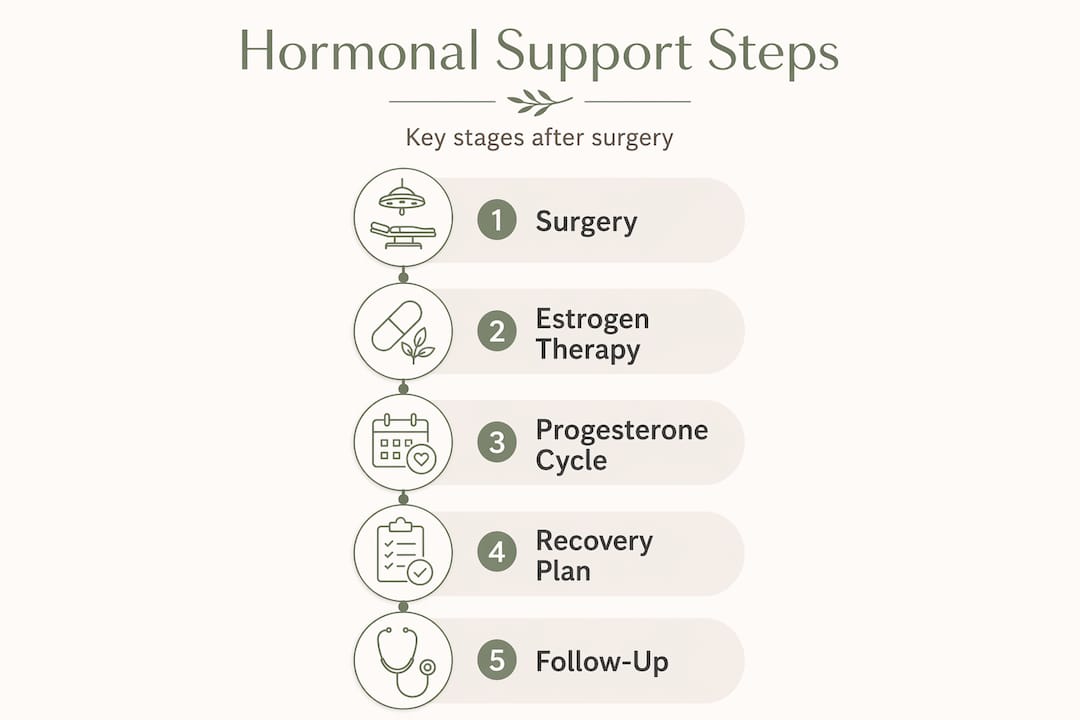

Knowing what hormonal support involves allows us to see who it can best help after surgery. The clearest evidence sits with one specific group: women who experience sudden, surgical menopause.
When ovaries are removed or stop functioning due to surgery, estrogen levels drop sharply overnight. This is not the gradual transition of natural menopause. It is abrupt, and the body notices. Hot flashes, joint pain, brain fog, vaginal dryness, and accelerated bone loss can begin within weeks. For these women, post-surgery hormone therapy is not optional wellness support. It is medically indicated.
Benefits of hormone therapy post-surgery for this group include:
Hormone therapy benefits outweigh risks in women younger than 60 or within 10 years of menopause onset when no contraindications exist, particularly after ovary removal causing abrupt hormone loss.
Contraindications matter here. Women with a history of estrogen-sensitive cancers (certain breast or uterine cancers), active blood clots, or specific vascular conditions need a different conversation with their provider. Hormonal balance after surgery is the goal, but not at the cost of a serious health risk.
Women recovering from fertility procedures without ovarian loss sit in a different category. Their ovaries still function. The question for them is whether adding exogenous estrogen improves surgical outcomes, and that is where the evidence gets genuinely complicated.
Pro Tip: If you had your ovaries removed or experienced surgical menopause, ask your provider about starting hormone therapy within the first few weeks post-surgery. The timing window matters for both safety and long-term benefit.
Having explored who benefits broadly, let’s examine evidence in a key condition affecting many women. For Asherman’s syndrome, post-surgical hormonal support is almost universally prescribed after hysteroscopic adhesiolysis. The assumption is that estrogen will stimulate the endometrium to regenerate and reduce the chance of adhesions reforming. It sounds logical. The clinical evidence, however, is more sobering.
Here is how outcomes compare based on current research:
| Treatment approach | Adhesion recurrence | Menstrual improvement | Pregnancy outcomes |
|---|---|---|---|
| Adhesiolysis alone | Moderate recurrence | Variable | Limited data |
| Adhesiolysis + standard estrogen | Similar recurrence | Modest improvement | No clear advantage |
| Adhesiolysis + high-dose sequential HRT | Lower recurrence (retrospective) | Better outcomes reported | Improved in some studies |
| Adhesiolysis + adjuncts (IUD, gel) | Under investigation | Variable | Inconclusive |
Randomized trials show that hormonal support after hysteroscopic adhesiolysis does not significantly reduce adhesion reformation or improve menstrual outcomes compared to no hormonal therapy. A 2025 trial confirmed no significant difference in adhesion reformation rates or menstrual improvements with estrogen therapy after adhesiolysis.
This does not mean estrogen is useless after postoperative care. It means we cannot rely on it as a guaranteed fix. The evidence supports using it as one part of a broader plan, not as the plan itself.
Pro Tip: If your provider prescribes estrogen after adhesiolysis, ask what else is being done to reduce adhesion recurrence. A single medication without follow-up hysteroscopy or adjunct therapy is rarely enough for moderate to severe cases.
For severe adhesion cases, combining hormonal therapy with specific surgical techniques may offer better outcomes than either approach alone. This is where the most interesting recent data sits.
A 2025 retrospective cohort study showed that high-dose sequential estrogen and progesterone after hysteroscopic cold knife adhesiolysis improved uterine cavity recovery and pregnancy outcomes compared to surgery alone. This is meaningful because cold knife separation is a more precise technique for severe cases, and pairing it with aggressive hormonal priming appears to give the endometrium a better environment to rebuild.
Key findings from this approach include:
| Outcome measure | Surgery alone | Surgery + high-dose sequential HRT |
|---|---|---|
| Uterine cavity recovery | Partial in severe cases | More complete recovery reported |
| Clinical pregnancy rate | Lower | Higher in retrospective data |
| Adhesion recurrence | Moderate to high | Reduced short-term |
| Endometrial thickness | Variable | Improved in most patients |
The mechanism makes sense. High-dose estrogen floods the endometrial receptors, encouraging rapid proliferation. Progesterone then supports differentiation and stability. When timed carefully after surgery, this sequential approach may give the uterus a better chance to heal before scar tissue can reform.
Pro Tip: This approach is not yet standard care and should only be pursued under a specialist experienced in severe intrauterine adhesions. Ask specifically about advanced therapies if you have Grade 3 or higher adhesions.
With the science understood, let’s focus on how you can apply this knowledge safely and effectively. Post-treatment hormonal support options are not one-size-fits-all, and knowing the right questions to ask puts you in a much stronger position.
Before starting any hormonal regimen, make sure these boxes are checked:
Hormone therapy safety involves screening for contraindications, personalized timing, and regular reassessment, as emphasized by expert guidelines. This is not a prescription you fill once and forget.
Here is a practical timing guide for starting postoperative hormonal care:
Pro Tip: Hormonal support aids recovery but rarely works in isolation. If your provider’s plan ends at “take this estrogen and come back in three months,” push for a more detailed monitoring schedule.
Here is the perspective that most clinical summaries skip: the women who do best after Asherman’s surgery are not the ones who found the perfect estrogen protocol. They are the ones who found a specialist willing to stay in the process with them.
Hormonal support is necessary. It is also genuinely not sufficient. The multimodal approach in fertility-focused Asherman’s care combines hormonal support with repeat surgeries and other adjuncts to optimize endometrial receptivity. That word “repeat” is important. Many women need more than one hysteroscopy. Many need their hormonal regimen adjusted based on how their endometrium responds. This is an iterative process, not a linear one.
“Hormonal therapy may be paired with repeated interventions and adjuvants, reflecting an iterative, evidence-limited process in real-world practice.”
What this means for you practically: if your first round of treatment does not produce the results you hoped for, that is not failure. It is information. A good specialist will use it to adjust the plan. A less experienced one may simply repeat the same approach and call it standard care.
The importance of hormonal support is real. But so is the importance of not outsourcing your entire recovery to a prescription pad. Track your symptoms. Know your cycle. Show up to follow-up appointments with specific questions. Advocate for holistic recovery planning that includes hormonal support as one tool in a larger kit.
Patient experience in this space varies enormously, not because the condition is unpredictable (though it is), but because the quality and continuity of specialist care varies just as much. The women who navigate this best are the ones who understand their own treatment well enough to notice when something is off.
Navigating post-surgical hormonal support is hard enough without having to piece together information from scattered medical journals and online forums at 2am. The Asherman’s Compass was built specifically for this moment in your recovery.
The complete Asherman’s recovery guide covers hormonal support, surgical recovery, fertility planning, and the specialist-ready question scripts you need to walk into appointments prepared. If you want to track how your body is responding to treatment over time, the recovery tracker tool helps you monitor symptoms, cycle changes, and endometrial response in one place. And when you need to hear from someone who has actually been through it, personal recovery stories from real women offer the kind of grounded perspective no clinical paper can provide. Ten percent of every purchase goes directly to the Compass Fund, supporting specialist care for women who need it most.
Pro Tip: Regular tracking of your symptoms and treatment response gives you real data to bring to every appointment, and it helps you spot patterns your provider might otherwise miss.
It involves using hormone medications, mainly estrogen and sometimes progesterone, to support your body’s healing and hormone balance after surgery following reproductive procedures.
No. Randomized trials show hormonal therapy does not consistently reduce adhesion recurrence, so it is typically combined with other treatments and close monitoring rather than used alone.
Women under 60 or within 10 years of menopause onset without contraindications benefit most from hormone therapy after surgical menopause, particularly when ovaries have been removed.
These therapies show promise in retrospective data, but long-term evaluation is still needed. They should only be used under specialist supervision, not as a standard first-line approach.
Ask about the type of hormones recommended, the timing, expected benefits, contraindications, and how the regimen fits your fertility goals. Individualized risk-benefit discussion is essential before starting any hormone therapy after surgery.
Article generated by BabyLoveGrowth
The Complete Asherman's Compass Guide covers everything from diagnosis to recovery — written from lived experience, backed by evidence.
Get the Complete Guide — $97Medical Disclaimer: This article is written from personal experience and is for informational purposes only. It is not medical advice. Please consult a qualified healthcare professional for diagnosis and treatment. The Asherman's Compass does not provide medical diagnoses.
Last reviewed: May 2026