Pelvic Floor Recovery After Uterine Surgery

Uterine surgery changes more than you expect. Most women know to rest and avoid lifting, but fewer know what’s quietly happening to their pelvic floor in the weeks that follow. Pelvic floor recovery after uterine surgery is one of the least talked about parts of the healing process, yet it affects bladder control, pelvic pressure, sexual function, and long-term comfort. Whether you’ve had a hysterectomy, myomectomy, or a uterine procedure for Asherman’s syndrome, your pelvic floor needs specific, thoughtful attention to heal well. This guide gives you that roadmap.
Table of Contents
- Key Takeaways
- What you need before starting pelvic floor recovery after uterine surgery
- Step-by-step pelvic floor exercises after uterine surgery
- Lifestyle and self-care for pelvic floor strength after surgery
- Troubleshooting common pelvic floor recovery challenges
- What successful recovery actually looks like
- My perspective on what actually helps
- Your next step in pelvic floor recovery
- FAQ
Key Takeaways
| Point | Details |
|---|---|
| Wait for clearance | Get surgeon approval, usually around 6 weeks, before starting any pelvic floor exercises. |
| Match rehab to symptoms | Exercises for muscle weakness differ from those for muscle tension; one approach does not fit all. |
| Breathe to heal | Exhaling with effort reduces pelvic pressure and is one of the most underused recovery tools. |
| Protect internal healing | Lifting restrictions and pelvic rest apply even when you feel better, because internal tissue takes weeks longer to heal. |
| Seek professional support | A pelvic floor physical therapist can identify issues that generic programs miss entirely. |
What you need before starting pelvic floor recovery after uterine surgery
The most common mistake women make after uterine surgery is starting too soon, or waiting too long, because nobody gave them a clear timeline. Before you do a single pelvic floor exercise, you need two things: a symptom check and surgeon clearance.
Pelvic floor exercises typically start around 6 weeks post-hysterectomy, though your actual start date depends on your specific surgery type. An abdominal hysterectomy involves more layers of tissue repair than a laparoscopic or vaginal procedure, so your timeline may extend further. Your surgeon is the only person who can confirm when your internal healing is far enough along.
Before you get that clearance, here’s what to track and communicate with your provider:
- Vaginal bleeding or discharge. Recovery typically involves bleeding and discharge for up to 6 weeks. Any increase after activity is a signal to slow down.
- Pelvic heaviness or pressure. A dragging sensation, especially when standing or walking, signals that your pelvic organs are working hard to adjust. Note when it occurs and how long it lasts.
- Bladder changes. Urgency, leaking, or difficulty emptying your bladder are all reportable symptoms, not embarrassing side effects to push through.
- Pain levels. Distinguish between soreness from movement and sharp or persistent pelvic pain, which needs evaluation.
| Surgery Type | Typical Clearance Window | Notes |
|---|---|---|
| Laparoscopic | 4–6 weeks | Least invasive, faster healing |
| Vaginal | 6 weeks | Internal tissue healing priority |
| Abdominal | 6–8 weeks | Longest recovery, most restrictions |
| Hysteroscopic (e.g., Asherman’s) | 2–6 weeks | Varies by adhesion severity |
Pro Tip: Before your post-op appointment, write down your symptoms in a simple log, including time of day, activity beforehand, and how long symptoms lasted. This gives your provider real data and helps you get a more specific rehab plan, not just a generic “you’re fine to start” clearance.
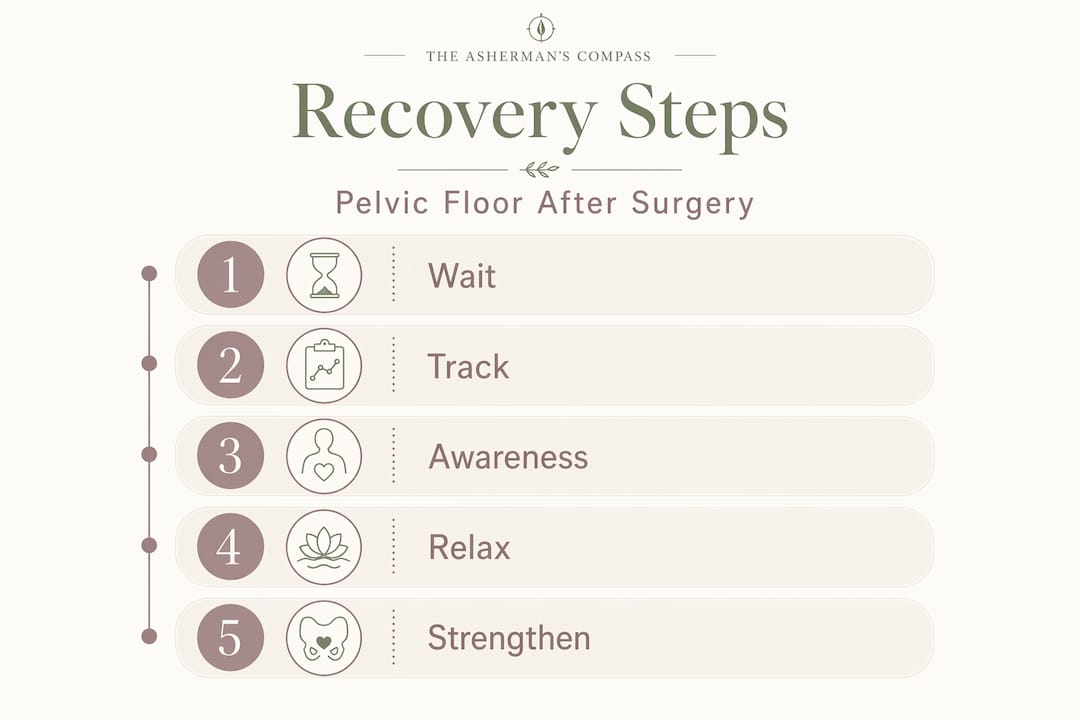
Understanding your surgery type also shapes what rehab looks like. Procedures for conditions like Asherman’s syndrome carry their own recovery nuances, which you can read about in this hysteroscopy recovery breakdown from Theashermanscompass.
Step-by-step pelvic floor exercises after uterine surgery
The goal in early recovery is not strength. It’s awareness and relaxation. Most women go straight to Kegels, which can actually worsen symptoms if your pelvic floor is already over-tense from surgery and guarding. Here is how to build a safe, effective progression.

Week 1 to 4 (before formal clearance)
These gentle movements support circulation and tissue healing without stressing the pelvic floor directly.
- Diaphragmatic breathing. Lie on your back with knees bent. Inhale slowly through your nose, letting your belly rise. Exhale fully through your mouth. Do 10 slow breaths, 2 to 3 times daily. This alone reduces pelvic floor tension by lowering intra-abdominal pressure.
- Short walks. Begin with 5 to 10 minutes once or twice daily, increasing only if symptoms stay stable. Walking gently engages the pelvic floor and prevents postoperative complications without overloading healing tissue.
- Ankle pumps and leg slides. Lying flat, flex and point your feet or slide one heel along the bed at a time. These activate circulation without any pelvic strain.
Week 6 and beyond (with clearance)
Once your surgeon clears you, you can begin structured pelvic floor muscle training. Proper technique involves contracting the pelvic floor muscles for 3 to 6 seconds, then fully releasing for 6 to 10 seconds. The relaxation phase is not optional. It is the point.
- Pelvic floor contractions. Sit or lie comfortably. Draw up the muscles you would use to stop the flow of urine. Hold for 3 to 6 seconds without holding your breath. Release completely for double the hold time. Repeat 8 to 10 times, twice daily.
- Glute bridges (modified). Lying on your back with knees bent, inhale to prepare, then exhale as you slowly lift your hips off the floor. Hold for 3 seconds, lower, and relax completely. This strengthens the glutes and hip muscles that support the pelvic floor without direct pressure.
- Side-lying leg lifts. Lying on your side with knees slightly bent, lift the top leg 6 to 8 inches and lower slowly. This targets the hip abductors, which are important for pelvic stability.
- Standing march. Hold a wall or chair for balance. Slowly lift one knee to hip height, lower, alternate. This builds coordination between your core and pelvic floor.
Pro Tip: Exhaling during the effort of any exercise, including lifting your hips or leg, reduces pelvic floor loading significantly. Breathing strategies are consistently underused in post-surgical recovery, yet they make a measurable difference in how your pelvic floor responds to each movement.
Lifestyle and self-care for pelvic floor strength after surgery
Exercise is only part of the picture. The choices you make every day during uterine surgery recovery have as much impact on your pelvic floor as any exercise program.
Pelvic rest and lifting restrictions. Internal tissue healing continues long after you stop feeling sore. Pelvic rest, meaning no vaginal penetration, is typically advised for 6 to 12 weeks. Lifting restrictions, usually no more than 20 pounds, apply for several weeks depending on your surgery. The reason women ignore this advice is that they feel fine. The problem is that feeling fine does not mean healed.
Bowel health. Constipation after surgery puts serious strain on the pelvic floor. Every straining episode creates downward pressure on tissues that are actively healing. Prioritize fiber, adequate hydration, and stool softeners if your provider recommends them. Never push to empty your bowels. Use a small footstool under your feet on the toilet to reduce strain naturally.
Additional self-care habits that support post-surgery pelvic health:
- Sleep position. For the first few weeks, sleeping on your back or side with a pillow between your knees reduces hip tension that feeds into the pelvic floor.
- Scar massage. Around 6 to 8 weeks post-surgery, gentle massage of any external scar tissue (when healed) can reduce adhesions and improve tissue mobility. Ask your physical therapist to demonstrate correct technique first.
- Posture awareness. Slouching compresses the pelvis. When sitting, place a small rolled towel at your lower back to maintain a neutral spine and reduce pelvic floor loading.
- Professional support. Pelvic floor physical therapy includes manual therapy, biofeedback, and targeted retraining that no at-home program can fully replicate. If you have any ongoing symptoms at 8 weeks, this is the referral to request.
The hormonal shifts that come with some uterine surgeries also affect tissue quality and healing speed. If you want to understand how that piece fits in, this guide on post-surgical hormonal support from Theashermanscompass is a solid starting point.
Troubleshooting common pelvic floor recovery challenges
Recovery is rarely linear, and the two most common problems women face are opposite issues that look similar from the outside: a pelvic floor that is too weak, and one that is too tight.
Matching your rehab to your actual symptoms rather than a generic protocol is what separates a smooth recovery from a frustrating one. A pelvic floor that is over-tense from surgical trauma responds poorly to more contractions. It needs breathing, stretching, and relaxation work first. A pelvic floor that is weak needs progressive loading, but only once the tissue is ready.
Warning signs that mean you need to stop and talk to your doctor or pelvic floor therapist:
- Worsening pelvic pain during or after exercise
- New or increasing heaviness or prolapse sensation
- Leaking that gets worse rather than better after starting exercises
- Burning, numbness, or stabbing pain in the pelvic region
- Any increase in vaginal bleeding
“If an exercise program is making your symptoms worse after three sessions, it is the wrong program for your body right now. This is not failure. It is data.”
Recovery anxiety is real and often underacknowledged. The fear of doing something wrong, reinjuring yourself, or not healing properly can lead to either over-exercising or complete avoidance. Both patterns delay recovery. If you find yourself paralyzed by uncertainty, working with a pelvic floor therapist even for two or three sessions gives you a personalized framework that removes the guesswork. For more on managing post-procedural pain and anxiety, pain management after uterine procedures is worth reading.
What successful recovery actually looks like
Recovery is not one milestone. It’s a series of small, measurable improvements over weeks and months. Pelvic floor rehab restores neuromuscular control disrupted by surgery, which means the improvements go beyond just “stronger muscles.” Women typically report better bladder control, reduced pelvic pressure, and improved comfort with daily activity.
| Recovery Milestone | Typical Timeline | What It Looks Like |
|---|---|---|
| Initial symptom reduction | Weeks 2 to 4 | Less pelvic heaviness, steadier bladder |
| Return to light exercise | Weeks 6 to 8 | Walking, gentle yoga, modified movement |
| Functional pelvic strength | Months 2 to 4 | Confidence with stairs, lifting, daily tasks |
| Full pelvic floor rehab completion | Months 3 to 6 | Symptoms resolved, cleared by therapist |
If you are still experiencing significant pelvic pain, urinary symptoms, or pressure beyond 3 months, request a formal pelvic floor therapy assessment. This is not routine monitoring. It is necessary care.
My perspective on what actually helps
I’ve watched so many women go into pelvic floor rehab after uterine surgery with the same instruction: do your Kegels. What I’ve learned, and what the research backs up, is that a Kegel-only program is the lowest bar approach to a complex recovery.
What I’ve found actually moves the needle is treating the pelvic floor as a pressure system, not just a collection of muscles. When you breathe well, manage intra-abdominal pressure, and coordinate your pelvic floor with your core and hips, the recovery is faster and more durable. Most women never get taught this.
The other thing I’d say honestly is this: starting too early because you feel okay is one of the most common setbacks I see. Internal tissue continues healing for weeks after you stop feeling sore. Feeling well is not clearance. Your surgeon’s sign-off is clearance.
If I could change one thing about how pelvic floor recovery is communicated to women after uterine surgery, it would be this: tell them the relaxation phase of every exercise matters as much as the contraction. Full relaxation between contractions is not resting. It’s training your nervous system to let go. That skill is what most women are missing, and it’s what most generic programs fail to teach.
— Daniella
Your next step in pelvic floor recovery
If this article has given you clarity, the work at Theashermanscompass goes much deeper. The complete recovery guide was built specifically for women navigating uterine procedures, pelvic health complications, and the very specific kind of uncertainty that comes with surgeries that aren’t well explained. It covers everything from post-operative symptom tracking to self-care protocols, with question scripts you can actually use at your next appointment.

You don’t have to piece your recovery together from scattered sources at 3am. Theashermanscompass puts it in one place, written by someone who walked this road first. Ten percent of every sale funds specialist care for women who can’t otherwise access it. Your recovery matters, and so does theirs. Start with the free Starter Kit and go from there.
FAQ
When can I start pelvic floor exercises after uterine surgery?
Most women receive clearance to begin structured pelvic floor exercises around 6 weeks post-surgery, though the exact timing depends on your surgery type and your surgeon’s assessment. Gentle breathing exercises can typically begin earlier.
What are the best exercises for pelvic floor recovery after surgery?
The best starting exercises are diaphragmatic breathing, short walks, and pelvic floor contractions with full relaxation between holds. Technique emphasizing full relaxation is just as important as the contraction itself.
How do I know if my pelvic floor is too tight or too weak after surgery?
A pelvic floor therapist can assess this through examination. At home, watch for signs like increased pain during contractions, difficulty releasing, or worsening symptoms with exercise, which can indicate over-tension vs. weakness and require different rehab approaches.
How long does full pelvic floor recovery take after uterine surgery?
Most women see meaningful improvement within 2 to 4 months of consistent rehab. Full recovery of pelvic floor strength and function typically takes 3 to 6 months, depending on surgery type, symptom severity, and whether professional therapy is involved.
Is pelvic floor physical therapy worth it after uterine surgery?
Yes. Individualized, supervised rehab produces better functional gains than self-directed programs alone, particularly because therapists can identify whether your symptoms stem from weakness or muscle tension and adjust treatment accordingly.
Recommended
- Recurrent Miscarriage & Uterine Adhesions: Is There a Connection? | The Asherman’s Compass
- Can You Get Pregnant With Asherman’s Syndrome? What I Learned | The Asherman’s Compass
- Post-surgical hormonal support: What women need to know | The Asherman’s Compass
- How to manage pain after Asherman’s procedure | The Asherman’s Compass
Ready to Understand Your Body Better?
The Complete Asherman's Compass Guide covers everything from diagnosis to recovery — written from lived experience, backed by evidence.
Get the Complete Guide — $97Medical Disclaimer: This article is written from personal experience and is for informational purposes only. It is not medical advice. Please consult a qualified healthcare professional for diagnosis and treatment. The Asherman's Compass does not provide medical diagnoses.
Last reviewed: May 2026