Choose Between Diagnostic Procedures: a Fertility Guide

When you’ve been told something is “probably fine” one too many times, getting a definitive answer becomes everything. This choose between diagnostic procedures guide exists for exactly that moment. Whether you’re working through a suspected Asherman’s syndrome diagnosis or sitting with the frustrating label of “unexplained fertility,” knowing which test to push for and why can change the entire trajectory of your care. This guide breaks down the options clearly, explains what each test actually tells your doctor, and helps you walk into your next appointment with the kind of informed confidence that gets results.
Table of Contents
- Key takeaways
- Your choose between diagnostic procedures guide starts here
- Factors that shape test selection
- How to prepare for diagnostic procedures
- Understanding your results and next steps
- My honest take on diagnostic decision-making
- Your next step doesn’t have to be another Google search
- FAQ
Key takeaways
| Point | Details |
|---|---|
| Start with less invasive tests | Clinicians typically begin with non-invasive options like ultrasound before recommending invasive procedures. |
| Sensitivity vs. specificity matters | A test that catches everything may also flag things that aren’t there. Understanding this balance helps you interpret results clearly. |
| Your history shapes test selection | A detailed symptom timeline helps your doctor choose the most targeted, accurate tests from the start. |
| More testing isn’t always better | Diagnostic yield, not test volume, is what drives meaningful clinical decisions and better outcomes. |
| Advocate for shared decisions | You have the right to understand every recommended test, its purpose, and what happens depending on the result. |
Your choose between diagnostic procedures guide starts here
Before anyone can treat Asherman’s syndrome or unexplained fertility, they need to see what’s actually happening inside your uterus and body. The problem is that the diagnostic options span a wide range, from a simple blood draw to a surgical procedure, and most women are never told how doctors decide which one to order first.
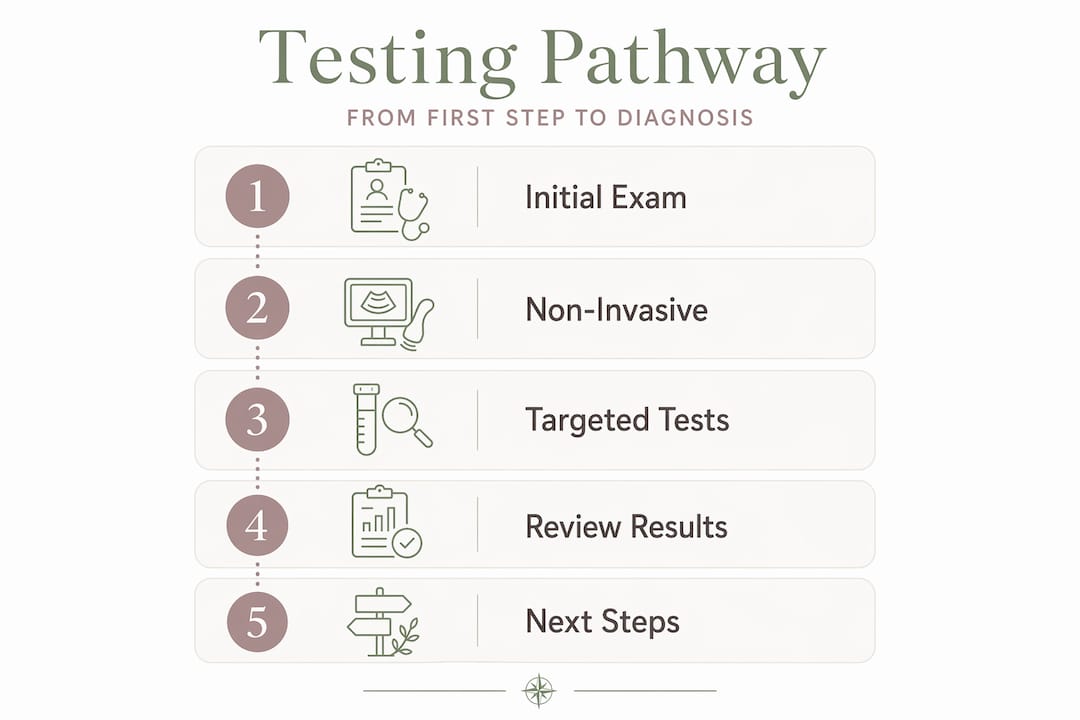
Clinicians prioritize tests that are less invasive, widely available, and relatively affordable before recommending anything more complex. That means the path usually starts with non-invasive options and escalates based on what those results reveal.
Non-invasive and imaging-based options
The first tier of testing tends to include:
- Blood tests. Hormone panels such as FSH, LH, AMH, and estradiol can reveal ovarian reserve issues and hormonal imbalances that affect fertility.
- Transvaginal ultrasound. A standard starting point for visualizing uterine structure, endometrial thickness, and signs of adhesions or polyps.
- Hysterosonography (saline infusion sonography). Saline is gently introduced into the uterine cavity to improve visualization. It’s more revealing than a standard ultrasound for detecting intrauterine abnormalities without requiring surgery.
Imaging and minimally invasive procedures
If first-line tests don’t give a clear enough picture, your doctor may recommend:
- Hysteroscopy. Currently considered the gold standard for diagnosing intrauterine adhesions. A thin camera is inserted into the uterus, giving a direct view of the cavity. It can be diagnostic only, or therapeutic if adhesions are removed at the same time.
- MRI. Less commonly used for Asherman’s specifically, but helpful when soft tissue detail is needed and other imaging is inconclusive.
- Laparoscopy. A surgical option that examines the outside of the uterus, fallopian tubes, and ovaries. Typically reserved for suspected endometriosis or other structural issues.
Understanding how tests are categorized
There’s an important distinction between screening tests (used when there’s no specific symptom but a risk exists), diagnostic tests (used to confirm or rule out a condition based on symptoms), and monitoring tests (used to track a known condition over time). For most women reading this, you’re in the diagnostic category. Appropriateness criteria guide radiologists and clinicians toward the most accurate and safe imaging choice based on the clinical question being asked.
| Test type | Invasiveness | Best used for |
|---|---|---|
| Blood tests | None | Hormonal assessment, infection markers |
| Transvaginal ultrasound | Minimal | Uterine structure, endometrial thickness |
| Hysterosonography | Low | Intrauterine abnormalities, polyps, adhesions |
| Hysteroscopy | Moderate | Confirming adhesions, direct uterine visualization |
| Laparoscopy | Surgical | Endometriosis, tubal or external uterine factors |
Factors that shape test selection
Choosing the right test is never a one-size-fits-all decision. It’s a layered process involving your symptoms, your history, the available tests, and what each option can realistically tell your care team.
Symptom severity and urgency
If you have significantly light or absent periods following a uterine procedure, your doctor may move faster toward hysteroscopy rather than spending months on less specific imaging. The severity of your symptoms directly informs how aggressive the diagnostic approach should be. You can see how Asherman’s syndrome is typically diagnosed by reviewing clinical evaluation steps in detail.

Accuracy: what sensitivity and specificity actually mean for you
These two terms sound technical but they’re genuinely useful to understand. Sensitivity refers to a test’s ability to correctly identify people who have a condition. Specificity refers to its ability to correctly identify people who don’t. Sensitivity and specificity are inversely related, meaning a highly sensitive test catches more true positives but also produces more false positives.
In practice, this means a highly sensitive test is great for ruling something out. A highly specific test is great for confirming it. Knowing which direction your test leans helps you interpret results without spiraling.
Risk, accessibility, and your preferences
Doctors consider your preferences and your ability to undergo a procedure when recommending diagnostics. Cost, travel, wait times, and emotional readiness are all legitimate variables. If you’re not ready for a surgical procedure, that conversation belongs in the room with your provider, not just in your head on the drive home.
Pre-test probability is another key concept. If your history strongly suggests Asherman’s based on a recent D&C and subsequent cycle changes, your doctor’s clinical suspicion is already high. That changes which test makes the most sense, because a positive result is far more likely to be meaningful.
Pro Tip: Before your appointment, write down every symptom with approximate dates, every uterine procedure you’ve had, and any medications you’ve taken. This symptom timeline is one of the most effective tools for helping your doctor order the right test from the start.
How to prepare for diagnostic procedures
Preparation sounds like a small thing, but it directly affects the quality of your results. And yet most women arrive at appointments without knowing what they were supposed to do beforehand.
Here’s a practical step-by-step approach:
- Document your medical history in writing. Include all past pregnancies, losses, procedures (especially D&Cs, hysteroscopies, or C-sections), and any known conditions. A detailed symptom timeline and full medication list before your visit helps clinicians choose the most targeted tests.
- Follow specific prep instructions for each test. Fasting requirements, for example, vary significantly. Fasting typically means avoiding all food and drink except water for several hours or overnight. Never assume the same rules apply across different procedures.
- Hydrate appropriately. Unless told otherwise, staying well hydrated before imaging tests generally improves visualization and makes blood draws easier.
- Bring a support person if possible. For more invasive procedures like hysteroscopy, having someone with you to ask questions or take notes reduces the cognitive load on you.
- Write your questions down before you go. Anxiety has a way of erasing your most important questions the moment the doctor walks in. Having them written down means you leave with actual answers.
Managing anxiety before procedures is worth taking seriously. If you’re worried about pain, it’s completely reasonable to ask in advance what pain management options are available. You can also read about managing pain after procedures so you know what to expect on the other side.
Pro Tip: Ask your doctor the night before whether there are any last-minute prep changes. Instructions sometimes differ based on which facility you’re attending or if your appointment time shifts.
Understanding your results and next steps
Getting your results back is rarely the end of the process. For many women with Asherman’s or unexplained fertility, it’s the beginning of a more specific conversation about what comes next.
What false positives and false negatives mean for you
A false positive means a test indicates a problem that isn’t actually there. A false negative means a test misses a problem that is. Neither is a failure of your body. They reflect the reality that tests are not perfect, and clinical context always matters more than a single result in isolation.
If your ultrasound looks clear but your symptoms strongly suggest adhesions, that’s not a reason to stop asking questions. It may be a reason to push for hysteroscopy.
When further testing becomes necessary
The following situations typically warrant escalating to a more invasive or specific test:
- First-line imaging is inconclusive despite ongoing symptoms
- A non-invasive test returns a positive result that requires confirmation
- Treatment has not worked as expected, suggesting the original diagnosis may be incomplete
- Your doctor’s clinical suspicion remains high despite normal results
Shared decision-making is not optional
You are not a passive recipient of diagnostic decisions. Unnecessary testing increases the risk of harm and anxiety, so the goal is targeted, not exhaustive. That means your care team should be explaining why they are recommending each test, what they expect it to show, and what happens next depending on the outcome.
If your doctor can’t explain why they’re ordering a test, that’s a signal to ask more questions, not to simply comply.
Ask specifically: What will a positive result mean? What will a negative result mean? What is the next step in either scenario? For invasive procedures especially, understanding the expected results and their implications for future treatment is your right, not a bonus.
My honest take on diagnostic decision-making
I’ve spoken with hundreds of women who walked out of appointments with a test result but no clarity. That disconnect is where so much pain lives.
What I’ve learned from my own experience, and from the women who’ve shared theirs with me, is that more testing doesn’t equal more answers. I spent time chasing results that didn’t change anything, because no one helped me understand what a meaningful diagnostic pathway actually looked like. Diagnostic yield, which is the probability that a test changes your management, is the question that should drive every recommendation. Not “what tests can we run?” but “which test will actually tell us something we can act on?”
I also want to name something that doesn’t get said enough: over-testing carries real costs. Not just financial. The anxiety of waiting for results that don’t pan out, the false alarms, the detours from treatment that actually helps. Targeted is better. Personalized is better. And you deserve a provider who thinks that way.
If you’re feeling overwhelmed by the options, that’s not a sign you’re not smart enough to understand them. It’s a sign the system hasn’t explained them well enough. That’s exactly what Theashermanscompass was built to fix.
— Daniella
Your next step doesn’t have to be another Google search
If you’ve read this far, you already know that choosing the right diagnostic path takes more than a quick appointment and a referral letter. It takes understanding what each test is for, what the results mean, and how to advocate when something feels incomplete. Theashermanscompass was built for exactly this stage of your journey. The complete recovery guide walks you through diagnosis, treatment, and recovery with 18 specialist-ready question scripts and a global directory of practitioners who actually understand Asherman’s and unexplained fertility. If you’re not sure where you stand yet, start with the free symptom quiz to get a clearer picture before your next appointment. You don’t have to piece this together alone.
FAQ
What is the first test doctors usually order for Asherman’s syndrome?
Transvaginal ultrasound is typically the first step, but hysterosonography or hysteroscopy is often needed to confirm intrauterine adhesions definitively, as it provides direct visualization of the uterine cavity.
How do sensitivity and specificity affect my diagnosis?
A highly sensitive test is better at ruling out a condition, while a highly specific test is better at confirming it. Since these metrics are inversely related, your doctor may use more than one test to get a full picture.
What should I bring to a diagnostic procedure appointment?
Bring a written list of your symptoms with dates, all past procedures, current medications, and your questions for the provider. This preparation directly improves the accuracy of test selection and results.
What does it mean if my test results are normal but I still have symptoms?
Normal results don’t always mean nothing is wrong. False negatives occur, and clinical suspicion based on your symptoms and history may warrant further testing, including more invasive options like diagnostic hysteroscopy.
How do I know when to push for a more invasive test?
If first-line imaging is inconclusive, symptoms persist, or treatment hasn’t worked as expected, ask your doctor directly about escalating to hysteroscopy or laparoscopy. Shared decision-making means you have a voice in this process.
Recommended
- Unexplained Infertility: Could Uterine Scarring Be the Answer? | The Asherman’s Compass
- How Is Asherman’s Syndrome Diagnosed? | The Asherman’s Compass
- The Asherman’s Compass — Your Complete Recovery Guide
- The Asherman’s Compass — Your Complete Recovery Guide
Ready to Understand Your Body Better?
The Complete Asherman's Compass Guide covers everything from diagnosis to recovery — written from lived experience, backed by evidence.
Get the Complete Guide — $97Medical Disclaimer: This article is written from personal experience and is for informational purposes only. It is not medical advice. Please consult a qualified healthcare professional for diagnosis and treatment. The Asherman's Compass does not provide medical diagnoses.
Last reviewed: May 2026