Asherman’s Syndrome Recovery Milestones Explained

Recovery from Asherman’s syndrome, clinically known as intrauterine adhesions (IUA), is not a straight line. It’s a series of distinct shifts, some physical, some hormonal, some deeply emotional, and knowing what to look for makes all the difference. Most women describe piecing together their asherman’s syndrome recovery milestones from scattered forums and medical abstracts at 2am. This article gives you one clear place to understand the full picture: what happens after surgery, what your body is telling you, when conception becomes realistic, and how to protect what you’ve worked so hard to restore.
Table of Contents
- Key Takeaways
- 1. Understanding the initial post-surgical healing phase
- 2. First follow-up imaging and cavity assessment
- 3. The return of menstrual flow as a recovery signal
- 4. Hormonal therapy and endometrial thickening targets
- 5. Emotional recovery as a true clinical milestone
- 6. Clearance for conception and fertility planning
- 7. Rehabilitation after Asherman’s syndrome in severe or recurrent cases
- 8. Long-term monitoring and managing recurrence risk
- My honest take on what recovery actually looks like
- Your complete recovery roadmap is one resource away
- FAQ
Key Takeaways
| Point | Details |
|---|---|
| Physical healing takes 4-6 weeks | Initial recovery after hysteroscopic adhesiolysis is measurable, but full uterine restoration takes longer. |
| Menstrual changes signal progress | Changes in flow, timing, or volume after surgery are meaningful indicators of uterine health. |
| Wait 1-3 cycles before conception | Attempting pregnancy too soon risks outcomes; let the endometrium fully re-establish first. |
| Recurrence requires active monitoring | Adhesions can reform, so follow-up imaging is not optional. It’s a core part of long-term recovery. |
| Emotional health shapes outcomes | Psychological confidence directly affects how well women advocate for their care and navigate setbacks. |
1. Understanding the initial post-surgical healing phase
The first Asherman’s syndrome recovery milestone most women encounter is simply getting through the first few weeks after hysteroscopic adhesiolysis. This is the surgical procedure used to cut and remove intrauterine scar tissue. Physical recovery typically spans 4-6 weeks, though what’s happening internally during that window is more nuanced than “rest and wait.”
Immediately after surgery, your specialist will likely place an intrauterine balloon or catheter device. Estrogen therapy and balloon placement are standard post-operative care designed to keep the uterine walls separated while healing occurs, reducing the chance of scar tissue reforming before the endometrium can regenerate.
What you may feel during these weeks:
- Cramping and spotting for the first few days, which is normal
- Some pelvic pressure if a balloon catheter is in place
- Fatigue and emotional heaviness, which are underreported but very real
- Light bleeding or discharge as the uterine lining begins to respond to hormonal support
Knowing how to manage pain after your procedure is something worth preparing for before surgery, not scrambling for afterward.
Pro Tip: Ask your surgeon before your procedure exactly how long your balloon catheter will stay in, what post-op estrogen protocol you’ll follow, and when your first follow-up hysteroscopy or imaging is scheduled. Having this information in advance prevents a lot of anxiety in week two.
2. First follow-up imaging and cavity assessment
One of the most important early post-surgery recovery milestones is your first follow-up imaging or repeat hysteroscopy. This is where you find out whether the uterine cavity has stayed open and whether the lining is beginning to thicken.
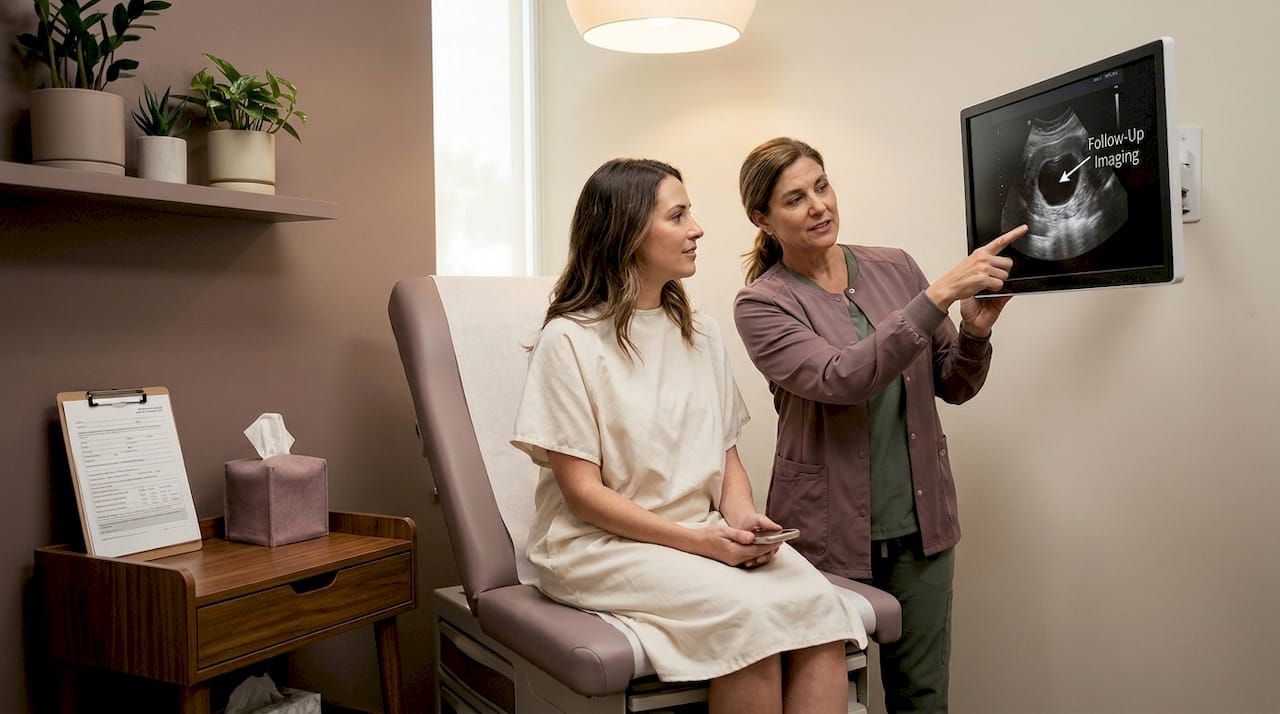
Many women expect a single surgery to resolve everything. The reality is that successful recovery often requires multiple hysteroscopy procedures combined with ongoing hormone therapy and anti-adhesion devices to maintain cavity patency over months. This is not a sign of failure. It is the expected course for moderate to severe cases.
Your surgeon may use a saline ultrasound (sonohysterogram) or office hysteroscopy to assess cavity shape and lining thickness. These findings guide your next steps. If the cavity looks good, you move toward the next milestone. If early re-scarring is detected, earlier intervention is scheduled before it compounds.
3. The return of menstrual flow as a recovery signal
One of the most emotionally loaded milestones in the Asherman’s recovery timeline is the return of your period. For many women, the absence or dramatic reduction of menstrual flow was the first sign something was wrong. Watching it come back, even imperfectly, matters deeply.
Menstrual changes are meaningful indicators of uterine health throughout recovery. Here’s how to read what you’re seeing:
- A return of flow, even light: Suggests endometrial tissue is regenerating. Lighter-than-normal periods may be expected in early recovery.
- Still very light or absent periods: May indicate the lining hasn’t thickened adequately yet, or that some adhesions remain. Worth discussing with your specialist before assuming the worst.
- Cramping without flow: A less common but important sign that the cervical canal may have scarring affecting outflow.
- Progressively heavier periods over cycles: Generally a positive sign that the endometrium is recovering volume and function.
Hormonal support enhances endometrial regrowth and plays a significant role in restoring menstrual function after surgery. If you’re on estrogen therapy, don’t stop it early without your doctor’s guidance, even if your period has returned. The lining needs time to fully rebuild its thickness and receptivity.
4. Hormonal therapy and endometrial thickening targets
This milestone is less visible than a returning period, but it may be the most clinically significant one in the Asherman’s recovery timeline stages. Endometrial thickness, measured by ultrasound, gives your fertility team a window into how well your uterine lining is actually recovering.
A lining of at least 7-8mm is generally considered the minimum threshold for embryo implantation. Many women with a history of intrauterine adhesions find their lining recovers to adequate thickness gradually across several cycles. Post-operative care regimens including estrogen therapy, antibiotics, and balloon catheter placement are designed specifically to support this process.
Tracking lining thickness across multiple ultrasounds gives you and your team objective data, not just a sense of how you feel. It also creates a record that helps if you need to switch specialists or escalate your care.
5. Emotional recovery as a true clinical milestone
Women navigating Asherman’s recovery consistently report that no one warned them about the psychological weight of it. The grief, the hypervigilance before every scan, the way a lighter period can unravel a week of progress. This is real, and it is part of the recovery picture.
Emotional support and psychological confidence are as important as physical healing in recovery. Research backs what patients already know: women who feel informed and supported advocate better for their care and experience better outcomes.
Patient education about recovery milestones empowers women to push back when a doctor dismisses their symptoms and to ask the right questions at every appointment. That self-advocacy is not separate from your physical recovery. It drives it.
6. Clearance for conception and fertility planning
This is the milestone most women are waiting for, and it comes with more nuance than a simple green light. Waiting 1-3 menstrual cycles before attempting conception after surgery gives the endometrium time to rebuild adequate thickness and receptivity.
Here’s what a solid fertility planning process looks like after Asherman’s treatment:
- Confirm cavity patency via follow-up hysteroscopy or sonohysterogram before attempting transfer or natural conception
- Have your lining thickness assessed mid-cycle in at least one or two cycles post-surgery
- Know your surgical team’s recommendation on timing before engaging your fertility specialist for embryo transfer
- Complete a fertility evaluation checklist to confirm all baseline metrics are within range before proceeding
- Discuss your unique history, including adhesion severity and number of surgeries, with your fertility specialist so your protocol is personalized
Coordinating surgical care and fertility treatment timelines is not just logistically helpful. Timing embryo transfer while the uterine cavity remains open and the lining is receptive directly impacts your chances of implantation. For women who have frozen embryos waiting, this coordination is particularly critical.
Pro Tip: If you’re planning an embryo transfer, ask your reproductive endocrinologist and your hysteroscopic surgeon to communicate directly with each other before setting your transfer date. This single step prevents a lot of preventable timing errors.
7. Rehabilitation after Asherman’s syndrome in severe or recurrent cases
For women with Grade 3 or Grade 4 adhesions, or those who’ve experienced recurrence after initial treatment, the recovery stages look different. Standard surgery may not be sufficient, and the path forward requires a higher level of specialization and patience.
Patients with severe cases often require multiple hysteroscopies and close fertility team coordination to achieve adequate uterine restoration. This is not a failure of any single treatment. It reflects the complexity of severe intrauterine scarring and the limits of what one procedure can accomplish.
Emerging options are also expanding what’s possible. Stem cell therapies show genuine promise for refractory cases, with successful pregnancies reported in clinical trial participants. These are not yet standard-of-care, but they represent a meaningful horizon for women who have exhausted conventional approaches. You can read more about the current evidence for stem cell treatment options as this research develops.
8. Long-term monitoring and managing recurrence risk
Reaching the milestone of successful surgery and recovering menstrual function does not mean recovery is over. Adhesion recurrence is a real risk, and long-term management requires ongoing vigilance.
| Risk Factor | Why It Matters | Recommended Action |
|---|---|---|
| Severity of original adhesions | Higher grade adhesions carry greater recurrence risk | Schedule regular follow-up imaging every 3-6 months |
| Multiple prior uterine procedures | Each procedure increases cumulative trauma to the lining | Discuss preventive anti-adhesion measures with your surgeon |
| Inadequate post-op hormonal support | Under-treatment accelerates re-scarring | Confirm your estrogen protocol in writing before discharge |
| Delayed follow-up imaging | Recurrence caught late is harder to treat | Don’t wait for symptoms; keep scheduled scans |
Recurrence risk is especially high in severe cases, and long-term management includes vigilant monitoring via regular imaging and subsequent interventions when necessary, often extending well beyond the initial phase of symptomatic recovery. The goal is catching re-scarring early, when it’s far easier to treat.
Self-care practices that support long-term uterine health include maintaining hormonal balance, avoiding unnecessary uterine procedures, and building a relationship with a specialist who knows your case history. Community support, whether online or through a trusted network, also matters more than most women expect. Knowing you’re not alone in this, and having access to others who’ve been through the same milestones, reduces the psychological burden significantly.
My honest take on what recovery actually looks like
I want to say something that most medical content won’t say: the clinical milestones are real, but they don’t capture what this recovery actually costs you.
What I’ve learned, both through my own experience and through the hundreds of conversations behind Theashermanscompass, is that the hardest part of this process isn’t the surgery or the waiting. It’s the uncertainty between one scan and the next. The month your period comes back and you let yourself hope, and then the follow-up shows re-scarring anyway.
What I’ve found actually works is not optimism for its own sake. It’s having a clear, specific picture of what each milestone means so you can track real progress rather than free-floating anxiety. Women who understand the Asherman’s recovery timeline explained in plain terms, who know what a follow-up hysteroscopy is looking for and why estrogen matters, show up to their appointments differently. They push back. They ask better questions. They don’t accept “it looks fine” as a complete answer.
Early intervention with an expert hysteroscopic surgeon is genuinely one of the most significant factors in long-term reproductive outcomes. The difference between a generalist and a specialist who performs hysteroscopic adhesiolysis regularly is not small. If you haven’t yet seen someone who specializes in this specifically, that step is worth prioritizing over almost everything else.
Recovery is not linear. But it is trackable. And that knowledge belongs to you.
— Daniella
Your complete recovery roadmap is one resource away
If this article gave you clarity, the full Theashermanscompass recovery guide takes it much further.
The Complete Recovery Guide covers everything in this article across 120 pages, with 10 structured chapters, 18 specialist-ready question scripts you can take directly into your appointments, and a global specialist directory to help you find the right surgeon for your case. It includes detailed recovery timelines, post-surgical hormonal support protocols, fertility planning guidance, and the kind of honest, experience-informed perspective that’s almost impossible to find in a standard clinical setting. For women who are tired of piecing this together from scattered sources, it’s the roadmap that should have existed on diagnosis day. You can also read Daniella’s story to understand where this resource came from and why it exists.
FAQ
How long does Asherman’s syndrome recovery take?
Physical healing after hysteroscopic adhesiolysis typically takes 4-6 weeks, but full uterine restoration, including endometrial regrowth and confirmed cavity patency, can take several months and multiple follow-up procedures.
When can I try to get pregnant after Asherman’s treatment?
Most specialists recommend waiting 1-3 menstrual cycles after surgery before attempting conception, allowing the endometrium time to adequately rebuild thickness and receptivity before implantation is attempted.
What does it mean if my period is still light after surgery?
Light periods after surgery may indicate the endometrial lining hasn’t fully recovered yet or that some adhesions remain. This warrants follow-up imaging rather than a “wait and see” approach.
Can Asherman’s adhesions come back after treatment?
Yes. Recurrence is a recognized risk, particularly in severe cases. Active monitoring through regular imaging or follow-up hysteroscopy is a non-negotiable part of long-term recovery management.
What are the signs that recovery is going well?
Positive signs include progressively returning menstrual flow, increasing endometrial thickness on ultrasound, confirmed cavity patency on follow-up imaging, and resolution of pain that was previously associated with blocked outflow.
Recommended
- Can You Get Pregnant With Asherman’s Syndrome? What I Learned | The Asherman’s Compass
- How to manage pain after Asherman’s procedure | The Asherman’s Compass
- Asherman’s Syndrome Symptoms: A Complete Checklist | The Asherman’s Compass
- Post-surgical hormonal support: What women need to know | The Asherman’s Compass
Ready to Understand Your Body Better?
The Complete Asherman's Compass Guide covers everything from diagnosis to recovery — written from lived experience, backed by evidence.
Get the Complete Guide — $97Medical Disclaimer: This article is written from personal experience and is for informational purposes only. It is not medical advice. Please consult a qualified healthcare professional for diagnosis and treatment. The Asherman's Compass does not provide medical diagnoses.
Last reviewed: May 2026