Why Symptoms Overlap Multiple Conditions: A Clear Guide

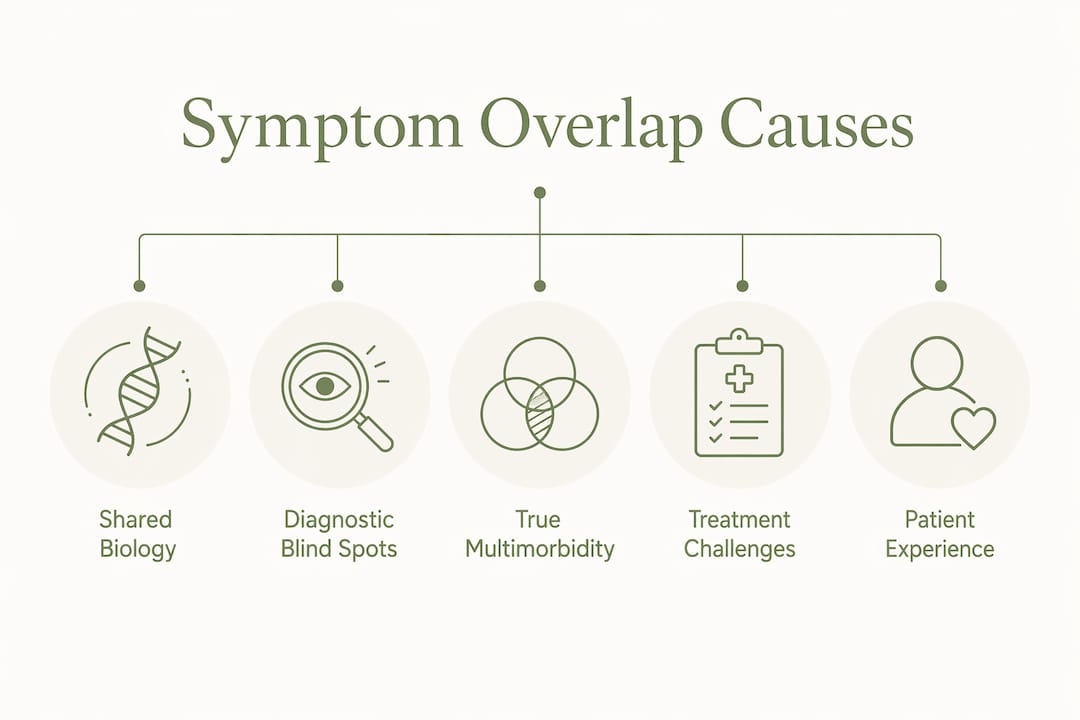
Symptom overlap is defined as the presentation of identical or near-identical symptoms across two or more distinct medical conditions, caused by shared biological pathways rather than diagnostic error. For women navigating reproductive health, this is not an abstract concept. Conditions like endometriosis, Asherman’s syndrome, fibroids, and irritable bowel syndrome (IBS) all produce pelvic pain, irregular bleeding, and fatigue because they activate the same underlying systems: immune dysregulation, chronic inflammation, and autonomic dysfunction. Understanding why symptoms overlap multiple conditions is the first step toward demanding a diagnosis that actually fits.
Why symptoms overlap multiple conditions: the biology behind it
The core reason symptoms appear across different conditions is that the human body has a limited set of responses to injury, infection, and dysfunction. Pain, fatigue, and bleeding are not unique to one disease. They are outputs of biological systems that multiple conditions can trigger simultaneously.
The three most significant shared pathways are:
- Immune dysregulation: The immune system misfires or overactivates, producing inflammation that damages tissue and generates pain signals. Endometriosis is classified as a systemic inflammatory disease, which explains why its symptoms extend beyond the pelvis to include fatigue, brain fog, and GI disturbance.
- Neuroinflammation: Inflammatory signals reach the central nervous system, amplifying pain perception and contributing to cognitive symptoms. This same mechanism explains why ME/CFS and fibromyalgia share fatigue, sleep disruption, and cognitive difficulties despite being classified as separate conditions.
- Autonomic dysfunction: The autonomic nervous system regulates heart rate, digestion, and hormonal signaling. When it is disrupted, symptoms like bloating, pelvic cramping, and irregular cycles can appear across reproductive, GI, and neurological diagnoses.
In reproductive health specifically, the inflammatory and oxidative stress pathways in endometriosis interact in a self-perpetuating cycle that damages tissue, disrupts hormonal balance, and produces symptoms that look identical to fibroids, adenomyosis, or even Asherman’s syndrome. The body is not confused. It is responding to real damage through the same limited toolkit it always uses.
Pro Tip: If your symptoms worsen cyclically, that pattern is biological data. Write down when symptoms peak relative to your period before your next appointment. Clinicians use menstrual-cycle timing as a primary clue to separate reproductive causes from GI or urinary ones.

How diagnostic overshadowing delays the right answer
Diagnostic overshadowing is a recognized healthcare quality problem. It occurs when an existing diagnosis causes a clinician to filter new or ongoing symptoms through that label, missing a second or third condition entirely. The result is that the patient’s full symptom picture is never properly assessed.
Women with reproductive health conditions face this problem at a disproportionate rate. A woman already labeled with IBS may have every pelvic complaint attributed to that diagnosis, even when endometriosis is the actual driver. A woman with a mental health diagnosis faces an additional layer: research confirms that physical symptoms are routinely ignored or attributed to anxiety, compounding delays in identifying overlapping physical illness.
The practical steps that counter diagnostic overshadowing are straightforward, but they require the patient to advocate actively:
- Document symptom timing. Note whether symptoms worsen before, during, or after menstruation. Cycle-linked GI or urinary symptoms point toward a gynecologic cause, not a primary GI disorder.
- Request a differential diagnosis conversation. Ask your doctor directly: “What else could this be?” Clinicians are trained to keep differentials broad, but time pressure often shortens that list prematurely.
- Separate your symptom narratives. Describe each symptom individually, including when it started and what makes it better or worse. This prevents one diagnosis from absorbing all your symptoms into a single, incomplete explanation.
- Seek a second opinion when symptoms persist. Premature diagnostic closure is a documented pattern in endometriosis care. Experts urge clinicians to keep endometriosis on the differential whenever symptoms have menstrual-cycle links or involve multiple body systems.
Pro Tip: Before any specialist appointment, write a one-page symptom summary organized by body system, not by what you think the diagnosis is. This format forces the clinician to see the full picture rather than anchoring on the first plausible explanation.
What happens when multiple conditions actually coexist
Symptom overlap does not always mean one condition is mimicking another. Sometimes two or more conditions are genuinely present at the same time. This is called multimorbidity, and it is more common than most patients realize.
Research on rheumatoid arthritis (RA) illustrates this clearly. Patients with RA have 2.29 times higher odds of multimorbidity compared to people without RA, and they accrue additional chronic conditions faster than healthy counterparts. The same principle applies in reproductive health. Women with endometriosis report three to ten times higher odds of also having fibroids, meaning their overlapping symptoms may reflect two real, simultaneous conditions rather than one misdiagnosed one.
The table below clarifies the practical difference between these two scenarios:
| Scenario | What it means | What it requires |
|---|---|---|
| One condition mimicking another | Shared biological pathways produce identical symptoms | Accurate differential diagnosis to identify the true cause |
| True multimorbidity | Two or more conditions are simultaneously active | Separate treatment plans that address each condition |
| Diagnostic overshadowing | An existing label absorbs new symptoms incorrectly | Active reassessment and broader clinical evaluation |
Recognizing true multimorbidity matters because treating only one condition leaves the other untreated. A woman managing endometriosis who also has uterine scarring from a prior procedure will not see full symptom resolution from endometriosis treatment alone. Both conditions need to be on the table.
Practical implications for women with reproductive health conditions
The most common misdiagnosis pattern in reproductive health runs like this: pelvic pain and bloating get attributed to IBS, heavy bleeding gets attributed to fibroids, and light or absent periods after a uterine procedure get dismissed as hormonal. Each of these can be correct. Each of them can also be wrong.
Endometriosis is commonly mistaken for GI disorders and fibroids because the symptom profiles genuinely overlap. Asherman’s syndrome, which involves intrauterine adhesions that form after procedures like a D&C, produces light periods, absent periods, and pelvic pain that can look like hormonal imbalance, premature ovarian insufficiency, or even depression-related cycle disruption. The conditions are biologically distinct. The symptoms are not.
Several practical tools help cut through this overlap:
- Menstrual-cycle tracking: Symptoms that worsen predictably around menstruation signal a gynecologic cause. GI symptoms that follow this pattern are more likely endometriosis than IBS.
- Definitive diagnostics: Laparoscopy remains the gold standard for confirming endometriosis, even in 2026. Ultrasound and blood tests can suggest it, but they cannot rule it out. Similarly, a saline infusion sonogram or hysteroscopy is required to diagnose Asherman’s syndrome. Understanding how Asherman’s syndrome is diagnosed helps you push for the right test rather than accepting inconclusive results.
- Comprehensive evaluation requests: Ask for a pelvic MRI, a referral to a specialist in reproductive endocrinology, and a review of your full symptom history, not just the most recent complaint.
- Second opinions: When a diagnosis does not explain all your symptoms, that gap is clinically significant. Unexplained infertility, for example, is frequently a case where uterine scarring has been missed because the presenting symptoms were attributed to another cause.
The most important thing you can do is treat symptom persistence as evidence. If treatment for one condition does not resolve your symptoms, the working diagnosis is incomplete.
Key takeaways
Symptoms overlap multiple conditions because shared biological pathways, diagnostic blind spots, and true multimorbidity all produce identical symptom profiles that require active, systematic evaluation to untangle.
| Point | Details |
|---|---|
| Shared biological pathways | Immune dysregulation, neuroinflammation, and autonomic dysfunction produce identical symptoms across different diseases. |
| Diagnostic overshadowing is real | Existing diagnoses cause clinicians to filter new symptoms incorrectly, delaying accurate identification of additional conditions. |
| Multimorbidity compounds overlap | Women with one reproductive condition have significantly higher odds of a second, requiring separate treatment for each. |
| Cycle timing is a diagnostic tool | Symptoms that worsen with menstruation point toward gynecologic causes, even when they appear GI or urinary in nature. |
| Definitive tests resolve ambiguity | Laparoscopy and hysteroscopy confirm what imaging cannot, making them necessary when symptoms persist across multiple systems. |
What I’ve learned about symptom overlap that doctors rarely say out loud
I spent years being told my symptoms were one thing when they were actually two things happening at the same time. That experience is not unusual. It is the norm for women with complex reproductive histories, and the medical system is not designed to catch it efficiently.
The part that frustrates me most is not the biology. The biology makes sense once you understand it. What frustrates me is that clinician expectations shape symptom interpretation in ways that consistently disadvantage women with previous health labels. If you have ever been told your pain is anxiety, or that your light periods are just stress, you have experienced diagnostic overshadowing firsthand.
The practical truth is this: symptom-based diagnostic categories do not always map cleanly to distinct biological conditions. The clinical grey areas between ME/CFS and fibromyalgia exist because the underlying biology overlaps. The same is true for endometriosis and Asherman’s syndrome. These are not competing diagnoses. They can coexist, and they often do.
What I wish someone had told me earlier is that your job in a medical appointment is not to present a tidy narrative. Your job is to present all the data, including the symptoms that do not fit the current diagnosis, and insist that they be explained. Unexplained symptoms are not irrelevant. They are the most important part of the picture.
— Daniella
How Theashermanscompass helps you make sense of it all

When your symptoms do not fit neatly into one diagnosis, the research rabbit hole can feel endless. Theashermanscompass was built specifically for this moment. Whether you are trying to understand whether your light periods point to Asherman’s syndrome, endometriosis, or both, the free symptom quiz gives you a structured starting point based on your actual symptom profile. The Complete Guide goes further: 120 pages of evidence-informed information, 18 specialist-ready question scripts, and a global specialist directory, all written by someone who has been exactly where you are. Because piecing this together alone at 3am is not a system. It is a gap that should not exist.
FAQ
Why do so many conditions share the same symptoms?
Most chronic and reproductive conditions activate the same biological systems, including immune dysregulation, inflammation, and autonomic dysfunction, which produce a limited set of shared symptoms like pain, fatigue, and cycle irregularities.
How does diagnostic overshadowing affect women with reproductive conditions?
Diagnostic overshadowing occurs when an existing diagnosis causes a clinician to attribute all new symptoms to that label, missing additional conditions. Women with endometriosis or prior uterine procedures are particularly vulnerable to this pattern.
Can endometriosis and Asherman’s syndrome occur at the same time?
Yes. Both conditions can coexist, and their symptoms overlap significantly. Pelvic pain, irregular bleeding, and fertility challenges are common to both, which is why definitive diagnostics like laparoscopy and hysteroscopy are necessary to distinguish them.
What is the most reliable way to diagnose overlapping reproductive conditions?
Laparoscopy remains the gold standard for confirming endometriosis, and hysteroscopy is required to diagnose Asherman’s syndrome. Imaging alone is insufficient when symptoms span multiple body systems.
When should I push for a second opinion?
Push for a second opinion when your current diagnosis does not explain all your symptoms, when treatment has not resolved your symptoms, or when a clinician dismisses cycle-linked pain or menstrual changes without further investigation.
Recommended
- Endometriosis & Uterine Scarring: How They Affect Fertility Together | The Asherman’s Compass
- Could You Have Asherman’s Syndrome? — Free Symptom Quiz
- How Is Asherman’s Syndrome Diagnosed? | The Asherman’s Compass
- Asherman’s Syndrome Symptoms: A Complete Checklist | The Asherman’s Compass
Ready to Understand Your Body Better?
The Complete Asherman's Compass Guide covers everything from diagnosis to recovery — written from lived experience, backed by evidence.
Get the Complete Guide — $97Medical Disclaimer: This article is written from personal experience and is for informational purposes only. It is not medical advice. Please consult a qualified healthcare professional for diagnosis and treatment. The Asherman's Compass does not provide medical diagnoses.
Last reviewed: June 2026