Why Period Disappeared After Surgery: What to Know

You just came out of surgery and your period has vanished. Maybe it was supposed to arrive last week, or it showed up once and then stopped completely. If you’re Googling “why period disappeared after surgery” at midnight, you’re not alone and you’re not overreacting. Menstrual cycle changes after surgery are more common than most surgeons mention in post-op instructions, and the reasons range from a temporary hormonal blip to a structural change that needs real medical attention. Here is what is actually happening in your body, what different surgeries do to your cycle, and when you need to push for answers.
Table of Contents
- Key takeaways
- Why period disappeared after surgery: the hormonal explanation
- Surgeries that directly change or stop your period
- Menstrual changes after weight-loss surgery
- When to seek medical advice
- Managing your recovery and supporting your cycle
- My honest take on missing periods after surgery
- Where to go from here
- FAQ
Key takeaways
| Point | Details |
|---|---|
| Surgery disrupts hormones temporarily | Surgical stress suppresses the hormonal signals that trigger ovulation, often delaying periods by weeks. |
| Surgery type determines the cause | Uterine, ovarian, and weight-loss surgeries each affect your cycle through different mechanisms. |
| Scarring is an overlooked culprit | Intrauterine adhesions from uterine procedures can block menstrual flow even when hormones are normal. |
| Three months is the key threshold | A period missing post surgery for more than three months warrants medical evaluation, not watchful waiting. |
| Recovery is usually possible | Most cycle disruptions after surgery resolve within one to twelve months depending on the procedure. |
Why period disappeared after surgery: the hormonal explanation
Your menstrual cycle is not a single organ doing one job. It depends on a precise chain of signals between your brain, your ovaries, and your uterus. When you undergo surgery, that chain gets interrupted at multiple points simultaneously.
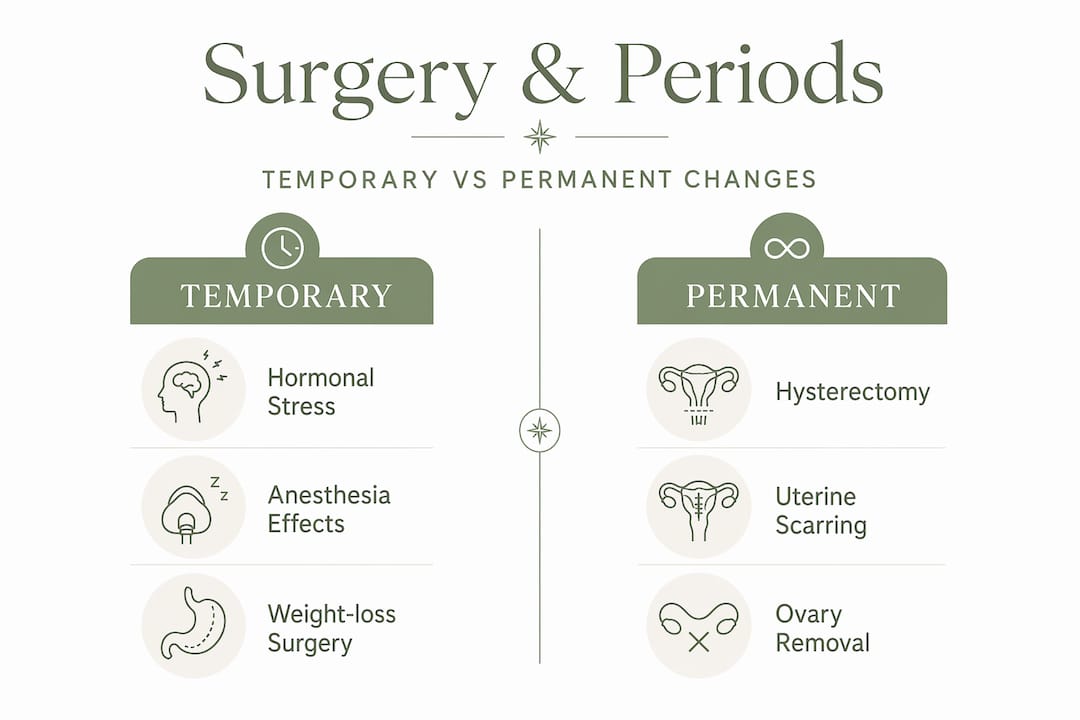
The biggest disruptor is surgical stress. Your body registers surgery as a physical threat and responds by releasing cortisol, the primary stress hormone. Elevated cortisol suppresses the hypothalamus, the brain region that releases gonadotropin-releasing hormone (GnRH). GnRH is the starting signal for everything else. Without it, the pituitary gland produces less luteinizing hormone (LH) and follicle-stimulating hormone (FSH), and ovulation gets delayed or skipped entirely. No ovulation means no progesterone surge, and without that surge, your uterine lining does not shed on schedule.
Anesthesia adds another layer. General anesthesia can disrupt hypothalamic function and your body’s circadian rhythms, both of which play a quiet but real role in cycle timing. Add post-surgical pain medications, antibiotics, and the disruption to your sleep and eating patterns, and your body has multiple reasons to put reproduction temporarily on hold.
The good news is that for most women who had procedures unrelated to the uterus or ovaries, cycles often resume within one to two months once recovery is underway and stress hormone levels normalize. Your body is not broken. It is prioritizing healing.
Pro Tip: Track the first day of your last period before surgery and note the surgery date. This gives you a concrete reference point when talking to your doctor about how long your cycle has actually been disrupted.
Surgeries that directly change or stop your period
Not all surgery-related period absence is temporary or hormonal. Some procedures create structural or permanent changes that explain exactly why your period disappeared. Understanding the difference matters because the treatment path is completely different.
| Surgery type | Mechanism of period change | Expected outcome |
|---|---|---|
| Total hysterectomy | Uterus removed; no lining to shed | Periods stop permanently |
| Partial/subtotal hysterectomy | Cervix retained; possible spotting | Reduced or absent bleeding |
| Ovarian surgery (cystectomy, oophorectomy) | Reduced hormone production | Irregular or absent cycles |
| D&C or uterine surgery | Intrauterine scarring possible | Light, absent, or trapped periods |
| Laparoscopy (non-uterine) | Hormonal stress response only | Temporary delay, 1-2 months |
A total hysterectomy means periods stop immediately because there is no uterine lining left to shed. But here is something most women are not told: if your ovaries were left intact, they continue cycling hormonally every month. You may still experience PMS-like symptoms including bloating, mood changes, and breast tenderness, on a predictable schedule. Ovarian function continues even without the uterus, so those monthly symptoms are real, not imagined.

The scenario that catches the most women off guard is uterine scarring after procedures like a D&C, hysteroscopy, or myomectomy. This is called Asherman’s syndrome, and it happens when scar tissue forms inside the uterine cavity, partially or fully blocking the menstrual flow. The blood is there; it simply cannot exit. You might have intrauterine adhesions reducing outflow without any obvious sign beyond a suddenly light or absent period. If you had any procedure inside the uterus and your period has significantly changed or vanished, this is the possibility that deserves investigation first. A detailed Asherman’s symptoms checklist can help you identify whether your experience fits the pattern.
Ovarian surgery is another category where periods can stop or become irregular. When ovarian tissue is removed, particularly through a bilateral oophorectomy, estrogen production drops sharply. The result can look like surgical menopause, with hot flashes, night sweats, and missing cycles. Even a unilateral cystectomy that removes a significant portion of one ovary can reduce the ovarian reserve enough to affect cycle regularity.
Menstrual changes after weight-loss surgery
Bariatric surgery sits in a category of its own when it comes to menstrual disruptions, and the mechanism has less to do with stress and more to do with fat tissue.
Estrogen is produced and stored in adipose tissue, not just in the ovaries. When you lose a significant amount of weight rapidly after gastric sleeve or bypass surgery, your body’s estrogen stores drop quickly. That shift can delay ovulation or stop your cycle entirely in the months immediately after surgery.
The metabolic changes compound this. Improved insulin sensitivity after bariatric procedures alters the signaling environment around the ovaries. Menstrual changes are common after gastric sleeve or bypass surgery and typically include:
- Irregular timing, with cycles arriving weeks early or late
- Heavier than normal bleeding as hormones fluctuate
- Complete absence of periods for one to three months
- Cycles that are shorter or longer than your pre-surgery baseline
The reassuring part is that bariatric surgery and period irregularities tend to resolve on a predictable timeline. Cycles normalize within 12 months for most women as estrogen and insulin levels stabilize at a new equilibrium. If you are more than a year out from weight-loss surgery and your cycle has not settled, that warrants a conversation with your gynecologist about hormonal evaluation.
One critical note for anyone who has had bariatric surgery: improved ovulation means improved fertility, sometimes dramatically and unexpectedly. A missing period post surgery might not be absence of ovulation. It might be pregnancy. Rule that out first.
When to seek medical advice
Knowing when to wait versus when to push for evaluation is genuinely tricky after surgery. Here is a clear framework to work from.
-
Rule out pregnancy first. Before any other explanation, take a home pregnancy test if there is any possibility. This applies even if you were told your fertility was affected by the surgery. Ovulation can return before your first expected period.
-
Wait up to three months for a non-uterine procedure. A period missing post surgery after a general procedure like appendix removal or knee surgery is almost always a hormonal stress response. Amenorrhea persisting for about three months is the practical benchmark to escalate care.
-
Act sooner after uterine procedures. If your period was absent or significantly lighter after a D&C, hysteroscopy, or any intrauterine operation, do not wait three months. Scar tissue can progress, and early diagnosis of Asherman’s syndrome leads to significantly better outcomes. Understanding how Asherman’s is diagnosed before your appointment will help you ask the right questions.
-
Request specific tests. A general “everything looks fine” is not sufficient. Ask for FSH, LH, estradiol, TSH, and prolactin levels. Thyroid dysfunction and elevated prolactin are two frequently missed causes of persistent amenorrhea after surgery that have nothing to do with the surgery itself but may have been triggered or unmasked by the physical stress.
-
Push for imaging. A pelvic ultrasound can identify fluid buildup (hematometra) caused by blocked menstrual flow or ovarian changes. If scarring is suspected, a hysteroscopy for Asherman’s evaluation is the only definitive diagnostic tool. Ultrasound can miss adhesions; hysteroscopy cannot.
Pro Tip: Bring a written timeline to your appointment: surgery date, last normal period before surgery, any changes since, and the specific symptoms you are experiencing. Doctors respond differently when the information is organized and concrete.
Managing your recovery and supporting your cycle
Once you understand the cause of your missing period, the path forward becomes clearer. Here is what actually supports cycle recovery depending on the situation.
- Nutrition matters more than most post-op advice acknowledges. Caloric restriction during recovery can compound the hormonal suppression already triggered by surgical stress. Eating enough fat, including healthy fats like avocado, olive oil, and nuts, supports estrogen production at the tissue level.
- Sleep is not optional during hormonal recovery. Your body releases most of its reproductive hormones at night. Poor sleep directly blunts GnRH pulsatility, extending the disruption.
- Track every change. Note cycle length, flow volume, pain, and any spotting. This data is what helps a specialist differentiate between a hormonal pattern and a structural problem.
- Ask about hormonal support. In some cases, a short course of progesterone can help trigger a bleed and restart the cycle. This is not appropriate for every situation, but it is worth asking about if cycles have not returned after two months.
- If scarring is diagnosed, timing matters. The window for treating Asherman’s syndrome adhesions is not unlimited. Scar tissue matures and thickens over time, making treatment more complex. Ask your specialist about the optimal timing for intervention rather than waiting to see if it resolves on its own.
The realistic timeline for cycle normalization after most non-reproductive surgeries is one to two months. After weight-loss surgery, up to twelve months. After uterine procedures with scarring, recovery depends entirely on the extent of adhesions and the treatment approach.
My honest take on missing periods after surgery
I have spoken with hundreds of women about surgery and period irregularities, and the pattern I see over and over is this: women are told “it’s just stress” without anyone checking whether something structural is also happening.
Both things can be true at the same time. Your HPO axis can be disrupted by surgical stress and you can have scar tissue forming in your uterus. Treating them as mutually exclusive is how women spend eighteen months being told to relax while Asherman’s progresses untreated.
What I have learned from my own experience and from the community at The Asherman’s Compass is that the women who get answers fastest are the ones who walk into appointments already knowing what questions to ask. They ask for a hysteroscopy, not just an ultrasound. They ask about intrauterine adhesions by name. They do not accept “wait and see” without a concrete timeline attached to it.
The hormonal effects of surgery on your cycle are real and usually temporary. But if your gut is telling you something more is happening, it probably is. Trust that. The information exists to help you figure it out, and you deserve a doctor who takes the question seriously.
— Daniella
Where to go from here
If your period disappeared after surgery and you still have more questions than answers, you are not at the end of the road. You are at the beginning of the right search.

Theashermanscompass was built specifically for this moment. The Complete Recovery Guide covers uterine scarring, missing periods, post-D&C complications, and the full diagnostic process in 120 pages written by someone who lived it. It includes 18 specialist-ready question scripts you can print and bring to your next appointment, a global specialist directory, and a self-care protocol for recovery. If you are not ready for the full guide, the free starter kit gives you the symptom checklist, what questions to ask your doctor, and where to begin. And if you are wondering whether your symptoms fit the Asherman’s pattern, the symptom quiz takes less than three minutes and gives you a clear starting point. Ten percent of every sale funds specialist care for women who cannot access it. You belong here.
FAQ
Why did my period disappear after surgery?
Surgery triggers a stress response that suppresses the hormonal signals controlling ovulation, causing periods to stop temporarily. If you had a uterine procedure, scar tissue may also be blocking menstrual flow.
When will my period return after surgery?
Most women see their cycle resume within one to two months after general surgery. After weight-loss surgery, the timeline can extend to twelve months as hormones stabilize.
Could Asherman’s syndrome cause my period to vanish?
Yes. Intrauterine adhesions from procedures like D&C or hysteroscopy can partially or fully block menstrual flow, making periods light or absent even when hormones are normal.
How long should I wait before seeing a doctor about a missing period after surgery?
Three months is the standard benchmark for non-uterine procedures. After uterine surgery, see a specialist sooner since scarring can worsen with time if left untreated.
Can anesthesia cause period irregularities?
Yes. Anesthesia can temporarily disrupt hypothalamic function and circadian rhythms, both of which affect menstrual cycle timing, usually resolving within one to two cycles.
Recommended
- Why Are My Periods So Light After a Miscarriage? What You Need to Know | The Asherman’s Compass
- Post-surgical hormonal support: What women need to know | The Asherman’s Compass
- Blog — The Asherman’s Compass
- Why Are My Periods So Light After a D&C? — The Asherman’s Compass
Ready to Understand Your Body Better?
The Complete Asherman's Compass Guide covers everything from diagnosis to recovery — written from lived experience, backed by evidence.
Get the Complete Guide — $97Medical Disclaimer: This article is written from personal experience and is for informational purposes only. It is not medical advice. Please consult a qualified healthcare professional for diagnosis and treatment. The Asherman's Compass does not provide medical diagnoses.
Last reviewed: May 2026